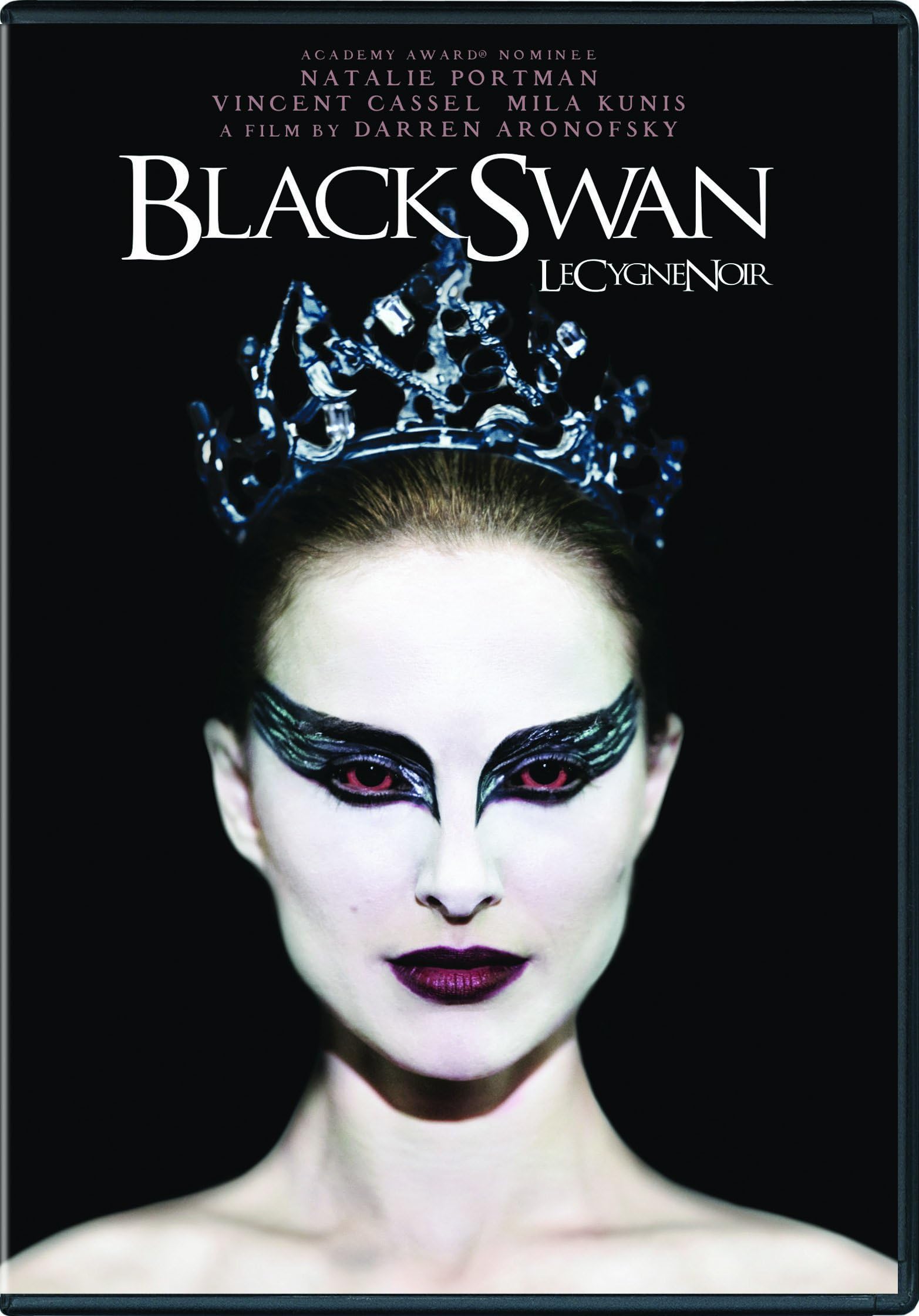
Black Swan (2010)
Product ID: 29363147
Desertcart purchases this item on your behalf and handles shipping, customs, and support to Cayman Islands.
Feverish worlds such as espionage and warfare have nothing on the hothouse realm of ballet, as director Darren Aronofsky makes clear in Black Swan, his over-the-top delve into a particularly fraught production of Swan Lake. At the very moment hard-working ballerina Nina (Natalie Portman) lands the plum role of the White Swan, her company director (Vincent Cassel) informs her that she'll also play the Black Swan--and while Nina's precise, almost virginal technique will serve her well in the former role, the latter will require a looser, lustier attack. The strain of reaching within herself for these feelings, along with nattering comments from her mother (Barbara Hershey) and the perceived rivalry from a new dancer (Mila Kunis), are enough to make anybody crack… and tracing out the fault lines of Nina's breakdown is right in Aronofsky's wheelhouse. Those cracks are broad indeed, as Nina's psychological instability is telegraphed with blunt-force emphasis in this neurotic roller-coaster ride. The characters are stick figures--literally, in the case of the dancers, but also as single-note stereotypes in the horror show: witchy bad mommy, sexually intimidating male boss, wacko diva (Winona Ryder, as the prima ballerina Nina is replacing). Yet the film does work up some crazed momentum (and undeniably earned its share of critical raves), and the final sequence is one juicy curtain-dropper. A good part of the reason for this is the superbly all-or-nothing performance by Natalie Portman, who packs an enormous amount of ferocity into her small body. Kudos, too, to Tchaikovsky's incredibly durable music, which has meshed well with psychological horror at least since being excerpted for the memorably moody opening credits of the 1931 Dracula, another pirouette through the dark side. --Robert Horton Review: A Phenomenal Blend of Beauty, Horror, Tragedy, and Triumph - Black Swan is one of the best movies I've ever seen. I just saw it a few days ago and I plan to see it a few more --or maybe a few more than "a few" times-- before it leaves the theaters. And I know I'll buy the DVD when that comes out and watch it more times with the luxury of being able to study why it worked so well by virtue of my DVD player's pause, rewind, and slow-motion buttons. In this review I will explain why the movie had such an impact on me and then in a section below the word "spoilers" I will make a few comments about the plot and particularly the ending. Why was it so compelling a film? Because it was a powerful story, brilliantly executed, and with incredible performances by four of the lead cast. The story line is quite gripping. We watch someone who is beautiful, talented, driven to perfection and incredibly fragile take on a performance that quite literally pushes her into a psychotic break. We cheer for Nina Sayers; we pity her; and we fear for her as the twisty plot unfolds springing surprises on the viewer along the way. The film is beautifully staged. It made ballet accessible for me and I imagine a lot of other people who were not into it. I found both Natalie Portman and Mila Kunis's dancing to be very convincing and moving. The film deftly presents us with moments of beauty (especially Nina's ultimate performance as the Black Swan) and moments of horror when the film plays its little tricks to convince us she is losing her mind. The performances were what sold it in the end. Natalie Portman's portrayal of Nina was utterly convincing as someone teetering on the edge of madness. And I suspect I'm not alone among guys who would find themselves wishing they could rescue her from her plight. Mila Kunis, Vincent Kassel, and Barhara Hershey also did tremendous work. Mila made a wonderful foil to Nina as Lily, the embodiment of what the Black Swan should have been...a carefree, beautiful, sexy woman. Vincent Kassel in the role of Thomas Leroy gave a performance that ensured a character that could have amounted to a hateful cliche was believable and one could easily understand why Nina would find him so captivating and overwhelming. Finally, Barbara Hershey turned in a fine performance as Nina's damaged mother, someone who loved her daughter but in a way that was twisted and malign and profoundly unnerving. You'll notice I left out Winona Ryder from my list above. It's not that she did a bad job in the part she played of Beth, the former prima ballerina. It's just that the character was such a small part...it could have been done by anyone. I find myself wondering if there were scenes involving her that wound up on the cutting room floor since a draft of the shooting script I saw had more scenes with her in it. It's not a flaw to the movie but I do wonder why an actress of Ryder's caliber was willing to do such a small role. A lot has been made of "anger and ecstasy fueled lesbian hate sex" between the characters of Nina and Lily. I actually thought there were other scenes that were sexier (Nina "touching herself" and a scene where Thomas shows Nina what it's like to be seduced). It's also important to remember that Nina and Lily's encounter was just a figment of Nina's burgeoning psychosis and also an indicator of how repressed she was (it was pretty clear she was a virgin). I also think that critics who describe the relationship between Lily and Nina as a "twisted friendship" are missing the boat on that. The friendship is only twisted as seen through Nina's distorted view. I think that Nina's psychosis assigned Lily, the role of nemesis and rival that she really did not play in reality. Finally, here are my thoughts about the ending. It's been the subject of a lot of debate on the Internet Movie Database. Some people are convinced that Nina died in the end after giving a phenomenal performance as the Black Swan...that when she thought she killed her "rival" Lily, she only managed to wound herself with a shard from the mirror she broke. I think the movie is deliberately ambiguous about what really happened. My interpretation of what did was that Nina did manage to hurt herself but not all that badly...which would explain why she was able to to perform as the Black Swan and the White Swan instead of being found in a pool of her own blood in her dressing room. I flatly reject the idea that she could have danced the way she did if she was as badly hurt as she was. I think it's more believable to conclude that Nina may have been convinced she had mortally wounded herself but was simply overcome by her psychosis and the fact that in the end she really had pulled it off and become perfect. Review: A Compelling Look Into The Crucible of Ballet - The beloved ballet "Swan Lake" is the most beautiful and compelling of all ballets. But, the film "Black Swan" is its destroyer -- a psycho dramatic voyage into the underworld of ballet. Nina Sayers, a budding ballerina extraordinaire, finds herself in a waking nightmare as she ventures as a maiden into the domain of the black swan. The pressure on Nina is intense. For starters, she dwells in the crucible of the all-consuming world of a New York ballet company. At home, she fends off the hovering presence of an overbearing mother, a former ballet dancer who never made it out of the corps not even to soloist let alone to principal dancer. Her dual dominance of her daughter runs hot and cold from loving acceptance to grim disapproval. She wants her daughter to succeed and yet, perhaps not too much. Nina has no close friends in the ballet company with its cutthroat competiveness. Yet the company is her life force. Bereft, too, of normal sexual release with another, the sole focus of her physical body is as an object of the dance. It is the presence of Lily, the free spirited newcomer to the company that pushes Nina's buttons, driving her unbearably. I couldn't help noting Lily as a take-off on Lilith, the dark soul who in Jewish folklore is to have been Adam's first wife before the creation of Eve. There is a real-life experience of complete mental collapse in the ballet world. It is known that the Russian ballerina Olga Spessivtseva was institutionalized for twenty years in an upper New York state hospital before being released. The ballerina had visited and intensely observed mental patients in preparation for the famed mad scene in the ballet "Giselle" and this led to her own bout with insanity. All in all, there is much that is out of sync in this film. The role of the prince in the ballet performance is danced by a guy named David (the name itself means beloved) whose emotions run only from A to B. He doesn't emotionally engage as he "walks the ballerina" in performance like a somnambulist. Nina Sayers is too much work for him. He even drops her in performance and later just looks dazed in bewilderment at her fate as the condemned swan. It's been said that ballet is woman, and yet, ballet is nowhere without a compelling male dancer. Margot Fonteyn writes in her book "The Magic Of Dance," (I am fortunate to have an autographed copy) that "Dance is very much an man's activity." I cannot imagine what ballet would be in today's world without the foregoing geatness of Rudolf Nureyev, my overall favorite dancer, and the charismatic talent of Mikhail Baryshnikov who made ballet respectable for the male dancer through his role in the ballet film "The Turning Point." Ballet would mean nothing for me today without the gentle excellence of Angel Corella, a principal dancer with American Ballet Theatre. In October of 1986, a ballet review that I wrote "The Paris Opera Ballet's Controversial Swan Lake" appeared in "The World & I," an international magazine of the Washington (DC) Times. This disturbing version was choreographed by Rudolf Nureyev as a nightmarish dream of the principal male character. It destroyed the beauty of the eternal vow made in traditional versions to Odette by the prince by never even acknowledging it. Nureyev, who danced in some performances as the prince and in others as the tutor, did not dance in the one I reviewed, implies that the prince is destroyed by the dark influence of his tutor who becomes his Rothbart. I did see Rudolf Nureyev dance in a production of "Romeo and Juliet" that he choreographed at the Metropolitan Opera on July 18, 1981. As Romeo, his greatness still shone brilliantly. Margot Fonteyn, however was relegated to dancing the role of Juliet's mother, Lady Capulet. After this performance, I saw Rudolf Nureyev outside the backstage entrance. I handed him an individual packet of a vitamin product that I had been selling. He took it, flashed that famous smile of his at me, and asked me what it was. I told him, vitamins. He then graciously autographed my program....one of my most cherished of all the autographs I've collected. The very best aspect of "Black Swan" is its incredible casting. Natalie Portman embodied Nina Sayers to perfection. She truly earned the Oscar she was awarded for Best Actress. Benjamin Millepied, principal dancer and choreographer with New York City Ballet, downplayed his charisma in the role of David and yet his smoldering presence came through. Vincent Cassel blew me away as the artistic director, fascinating me as much as he did Nina Sayers. I was stunned when I learned that he was an actor but not a dancer. Mila Kunis as Lily was compelling and I enjoyed her role but, other than in appearance, in no way did she resemble an actual ballerina. I can't imagine that a tattoo such as she displayed on her back would be tolerated in a major company and the ballerinas whom I have known were disciplined in the extreme...free spirits inside perhaps...but never, never in public nor on display. This film is a must for every true lover of ballet, if only for its glimpse into a dancer's world which never can be fully imagined from a pristine seat in the audience.
| Customer Reviews | 4.6 out of 5 stars 9,737 Reviews |
M**A
A Phenomenal Blend of Beauty, Horror, Tragedy, and Triumph
Black Swan is one of the best movies I've ever seen. I just saw it a few days ago and I plan to see it a few more --or maybe a few more than "a few" times-- before it leaves the theaters. And I know I'll buy the DVD when that comes out and watch it more times with the luxury of being able to study why it worked so well by virtue of my DVD player's pause, rewind, and slow-motion buttons. In this review I will explain why the movie had such an impact on me and then in a section below the word "spoilers" I will make a few comments about the plot and particularly the ending. Why was it so compelling a film? Because it was a powerful story, brilliantly executed, and with incredible performances by four of the lead cast. The story line is quite gripping. We watch someone who is beautiful, talented, driven to perfection and incredibly fragile take on a performance that quite literally pushes her into a psychotic break. We cheer for Nina Sayers; we pity her; and we fear for her as the twisty plot unfolds springing surprises on the viewer along the way. The film is beautifully staged. It made ballet accessible for me and I imagine a lot of other people who were not into it. I found both Natalie Portman and Mila Kunis's dancing to be very convincing and moving. The film deftly presents us with moments of beauty (especially Nina's ultimate performance as the Black Swan) and moments of horror when the film plays its little tricks to convince us she is losing her mind. The performances were what sold it in the end. Natalie Portman's portrayal of Nina was utterly convincing as someone teetering on the edge of madness. And I suspect I'm not alone among guys who would find themselves wishing they could rescue her from her plight. Mila Kunis, Vincent Kassel, and Barhara Hershey also did tremendous work. Mila made a wonderful foil to Nina as Lily, the embodiment of what the Black Swan should have been...a carefree, beautiful, sexy woman. Vincent Kassel in the role of Thomas Leroy gave a performance that ensured a character that could have amounted to a hateful cliche was believable and one could easily understand why Nina would find him so captivating and overwhelming. Finally, Barbara Hershey turned in a fine performance as Nina's damaged mother, someone who loved her daughter but in a way that was twisted and malign and profoundly unnerving. <SPOILERS> You'll notice I left out Winona Ryder from my list above. It's not that she did a bad job in the part she played of Beth, the former prima ballerina. It's just that the character was such a small part...it could have been done by anyone. I find myself wondering if there were scenes involving her that wound up on the cutting room floor since a draft of the shooting script I saw had more scenes with her in it. It's not a flaw to the movie but I do wonder why an actress of Ryder's caliber was willing to do such a small role. A lot has been made of "anger and ecstasy fueled lesbian hate sex" between the characters of Nina and Lily. I actually thought there were other scenes that were sexier (Nina "touching herself" and a scene where Thomas shows Nina what it's like to be seduced). It's also important to remember that Nina and Lily's encounter was just a figment of Nina's burgeoning psychosis and also an indicator of how repressed she was (it was pretty clear she was a virgin). I also think that critics who describe the relationship between Lily and Nina as a "twisted friendship" are missing the boat on that. The friendship is only twisted as seen through Nina's distorted view. I think that Nina's psychosis assigned Lily, the role of nemesis and rival that she really did not play in reality. Finally, here are my thoughts about the ending. It's been the subject of a lot of debate on the Internet Movie Database. Some people are convinced that Nina died in the end after giving a phenomenal performance as the Black Swan...that when she thought she killed her "rival" Lily, she only managed to wound herself with a shard from the mirror she broke. I think the movie is deliberately ambiguous about what really happened. My interpretation of what did was that Nina did manage to hurt herself but not all that badly...which would explain why she was able to to perform as the Black Swan and the White Swan instead of being found in a pool of her own blood in her dressing room. I flatly reject the idea that she could have danced the way she did if she was as badly hurt as she was. I think it's more believable to conclude that Nina may have been convinced she had mortally wounded herself but was simply overcome by her psychosis and the fact that in the end she really had pulled it off and become perfect.
B**Y
A Compelling Look Into The Crucible of Ballet
The beloved ballet "Swan Lake" is the most beautiful and compelling of all ballets. But, the film "Black Swan" is its destroyer -- a psycho dramatic voyage into the underworld of ballet. Nina Sayers, a budding ballerina extraordinaire, finds herself in a waking nightmare as she ventures as a maiden into the domain of the black swan. The pressure on Nina is intense. For starters, she dwells in the crucible of the all-consuming world of a New York ballet company. At home, she fends off the hovering presence of an overbearing mother, a former ballet dancer who never made it out of the corps not even to soloist let alone to principal dancer. Her dual dominance of her daughter runs hot and cold from loving acceptance to grim disapproval. She wants her daughter to succeed and yet, perhaps not too much. Nina has no close friends in the ballet company with its cutthroat competiveness. Yet the company is her life force. Bereft, too, of normal sexual release with another, the sole focus of her physical body is as an object of the dance. It is the presence of Lily, the free spirited newcomer to the company that pushes Nina's buttons, driving her unbearably. I couldn't help noting Lily as a take-off on Lilith, the dark soul who in Jewish folklore is to have been Adam's first wife before the creation of Eve. There is a real-life experience of complete mental collapse in the ballet world. It is known that the Russian ballerina Olga Spessivtseva was institutionalized for twenty years in an upper New York state hospital before being released. The ballerina had visited and intensely observed mental patients in preparation for the famed mad scene in the ballet "Giselle" and this led to her own bout with insanity. All in all, there is much that is out of sync in this film. The role of the prince in the ballet performance is danced by a guy named David (the name itself means beloved) whose emotions run only from A to B. He doesn't emotionally engage as he "walks the ballerina" in performance like a somnambulist. Nina Sayers is too much work for him. He even drops her in performance and later just looks dazed in bewilderment at her fate as the condemned swan. It's been said that ballet is woman, and yet, ballet is nowhere without a compelling male dancer. Margot Fonteyn writes in her book "The Magic Of Dance," (I am fortunate to have an autographed copy) that "Dance is very much an man's activity." I cannot imagine what ballet would be in today's world without the foregoing geatness of Rudolf Nureyev, my overall favorite dancer, and the charismatic talent of Mikhail Baryshnikov who made ballet respectable for the male dancer through his role in the ballet film "The Turning Point." Ballet would mean nothing for me today without the gentle excellence of Angel Corella, a principal dancer with American Ballet Theatre. In October of 1986, a ballet review that I wrote "The Paris Opera Ballet's Controversial Swan Lake" appeared in "The World & I," an international magazine of the Washington (DC) Times. This disturbing version was choreographed by Rudolf Nureyev as a nightmarish dream of the principal male character. It destroyed the beauty of the eternal vow made in traditional versions to Odette by the prince by never even acknowledging it. Nureyev, who danced in some performances as the prince and in others as the tutor, did not dance in the one I reviewed, implies that the prince is destroyed by the dark influence of his tutor who becomes his Rothbart. I did see Rudolf Nureyev dance in a production of "Romeo and Juliet" that he choreographed at the Metropolitan Opera on July 18, 1981. As Romeo, his greatness still shone brilliantly. Margot Fonteyn, however was relegated to dancing the role of Juliet's mother, Lady Capulet. After this performance, I saw Rudolf Nureyev outside the backstage entrance. I handed him an individual packet of a vitamin product that I had been selling. He took it, flashed that famous smile of his at me, and asked me what it was. I told him, vitamins. He then graciously autographed my program....one of my most cherished of all the autographs I've collected. The very best aspect of "Black Swan" is its incredible casting. Natalie Portman embodied Nina Sayers to perfection. She truly earned the Oscar she was awarded for Best Actress. Benjamin Millepied, principal dancer and choreographer with New York City Ballet, downplayed his charisma in the role of David and yet his smoldering presence came through. Vincent Cassel blew me away as the artistic director, fascinating me as much as he did Nina Sayers. I was stunned when I learned that he was an actor but not a dancer. Mila Kunis as Lily was compelling and I enjoyed her role but, other than in appearance, in no way did she resemble an actual ballerina. I can't imagine that a tattoo such as she displayed on her back would be tolerated in a major company and the ballerinas whom I have known were disciplined in the extreme...free spirits inside perhaps...but never, never in public nor on display. This film is a must for every true lover of ballet, if only for its glimpse into a dancer's world which never can be fully imagined from a pristine seat in the audience.
M**N
Gripping story in an unusual setting!
Much less realized in the fine arts than in, say, professional sports, is that the artists must compete with one another for the seats in the orchestra, the roles in Shakespeare, and, in this case, the starring role in the ballet. With superb writing, casting, staging, and direction, Black Swan makes this point with delicious perfection and tension, and even if you know nothing about ballet the art form, you'll understand what the people who wish to live it on the professional level must endure. The setting is perfect. Tchaikovsky's immense ballet Swan Lake demands not just one, but TWO magnificently difficult and exactly opposite characters be performed, usually, by a single dancer. So difficult is this that many ballet companies use two different dancers for the two roles. In Black Swan, the director believes the story carries much more impact and power if he can find the ONE dancer who can effectively realize both parts. The problem is, he finds only half the perfect performer. Superbly played by Natalie Portman, the character of Nina, he says, makes the perfect white swan, but fails to feel and convey the part of the evil black swan. She must dance like a virgin for the white swan, but become the evil and seductive temptress for the black swan. It helps at this point if you understand at least a little about ballet, but it is spelled out and shown what the director means, and you'll be able to go with it. She's sweet enough for the good girl but not nearly evil enough for the bad one. Well, this is already an interesting and powerful story, but then, you begin to realize that the Portman character, Nina, may be so deep into trying to become two different persons at the same time that the presence of a possible competitor, Lily (a brilliant Mila Kunis!) begins not only to add pressure but blur the line between the real and the imagined. I should toss in here that made a few decades ago, this is the kind of part Natalie Wood could have nailed, and a couple more decades back from that, Jean Harlow, before her untimely death at 26, was on her way to being able to realize roles like this. Natalie Portman is wonderful and richly deserving of the Best Actress Oscar she won for this role. As this all unfolds, it does not let us, the viewers, off the hook easily, and we begin to wonder for ourselves what is real and what is not. It becomes incredibly powerful. I won't spoil anything, but The Big Finish is incredibly impactful, driven by Tchaikovsky's absolutely magnificent music, and you will NOT have seen it coming! A fun added feature is a detailed splane and demonstration as to how it makes you believe that Portman, a powerful actress and graceful dancer but NOT a real ballerina, really DOES the dancing. She studied and even took ballet lessons, but still needed some creative movie making to put this all together. Up for a plethora of Oscars and other awards, Black Swan is magnificent on all levels. Click on it right this instant and be prepared for multiple viewings to be drawn into the multiple facets and levels it will lay out for you!
A**N
Not quite perfect...
Last year the world went kind of crazy for `Black Swan', the film that finally brought the world of Darren Aronofsky into the limelight for all to see. Aronofsky has been creating quality and uniquely intriguing films since the late 90's, and he has brushed Oscar's hand before (garnering acting nominations for `Requiem for a Dream' and `The Wrestler') but it was the bizarrely obsessive `Black Swan' that finally garnered him an acting win (Natalie Portman) as well as Best Picture and Best Director nominations. It surprises me that this film was `the one' since it is his most immature film to be quite honest. That isn't to say that it isn't littered with wonderful treats, and Aronofsky's manic yet oddly controlled direction was most deserving of a nomination, but at the end of the day this film is middle-brow Aronofsky at best. I told a friend that this film was like a strange blend of `The Red Shoes' and `Carrie' (two masterpieces) directed by Lars von Trier (genius auteur) with a more polished production thanks to a larger budget. Yes, `Black Swan' is an ugly duckling. The film centers around a young ballerina named Nina who is desperately seeking perfection. She wants the lead role in her company's revival of `Swan Lake' and she obsesses over the idea of being the Swan Queen, so much so that her whole world starts to take a dark tone. She is virginal and innocent and childlike in many ways, and so she lacks the otherworldly knowledge to play the dual role part, but she is talented and thus believed in and so she is given the part. Nina needs to break free from the constraints of her personality, but her upbringing (and her monstrously intrusive mother) makes it hard for her to `let go'. Then Nina meets Lilly, a young ballerina, new to the company, who possesses everything that Nina lacks; namely sex appeal. Nina becomes consumed with Lilly, mainly because she is afraid of her. She begins to suspect that Lilly only wants to take away the lead role from her, and when Lilly is made her alternate she begins to lose her mind with fearful anxiety. `Black Swan' is a very blunt film that doesn't really know the word `restraint', which to be honest is part of the appeal. The film doesn't hesitate to dive off the crazy train and make a free-fall for deeper waters, especially in the film's final act (which is a visceral work of genius). The preposterous of the film is highlighted and embraced by Aronofsky's fearless direction, and so you have to appreciate that that is the impression he wanted to make. Still, there is a feeling of cheapness that erodes some of my affection for the film. I also found that the film's ensemble was very lacking. There are no layers to these characters. They are mere caricatures, props for Aronofsky to toy with as he pleases. I know that a lot of hoopla was made over Natalie Portman and her eventual Oscar win, but I honestly didn't find a lot of depth in her performance. She was just crazy. She never really got under the skin of Nina, uncovering who she really was. Granted, the more I see and contemplate the film I gather that understanding the complexities of Nina wasn't really the point (this film is guilty pleasure personified) but a little depth explored would have fleshed her out and made her more understandable. Barbara Hershey was also kind of one-note and clichéd, and not in the way that made her interesting. Vincent Cassel was horrendous, his line readings were awkward and unbelievable. In fact, as much as her awards attention baffled me, Mila Kunis was probably the best performance in the film; creating someone we were enthralled with and toying with Nina in a playfully seductive and mysterious manner. And yet still, the film is electrifying and unforgettable. The cinematography, costume design, makeup, sound (OMG, the way you can hear every swipe of Nina's feet on the floor is to die for), editing and that beautifully haunting reworking of `Swan Lakes' score is just delicious to watch, and Darren Aronofsky knows exactly how to play the audience, drawing us in despite the film's apparent flaws. This may be Darren's most immature film, but it's quite possibly his best directorial accomplishment. So in the end, I can't hate this film. I don't understand the unabashed love for it, but I do understand the obsession over it. It is a film about obsession that captivates its central core by defining obsession. It oozes with charisma and sucks you in full throttle.
D**T
Reflecting on Black Swan from a depth psychological perspective
Black Swan asks us to consider whether we—as striving, individuating, and creative beings—should be the object or the subject of our own lives. The implications for going through the deep journey to integrate and heighten both the conscious (White Swan) and unconscious (Black Swan) aspects of ourselves can be devastatingly dangerous if done too quickly. Without a therapist, supportive family, somatic, or spiritual support—when the self is too vulnerable, fragile, stressed from the pressure of competition, and forced to embody a radically new role without adequate psychological preparation—Nina as heroine suffers psychic fracturing. Given the chance to dance the two roles, she is suited only for the white. The black role brings her to the edge of madness and causes her to be possessed by the archetype of the shadow. A provocative sequence that could be a dream, fantasy, hallucination, magical reality, or altered consciousness opens the film. Nina as White Swan is seen dancing with compelling force, joining with, enveloped by, then trying to escape, a dark human figure that turns into a caped dark figure who increasingly takes her over. We are aware from the outset that the movie is about a white, pure, and innocent heroine’s encounter with the shadow and darkness; whether this dark shadow is within or without her, we still need to discover. The closing scene shows her moment of shining glory; the dying or wounded heroine Nina is lying off-stage, the excited roars of the opening night’s New York City audience are in the background, and surrounded by admiring colleagues; blood is flowing out from the center of her body—perhaps this is from the solar plexus of individuation, control, and power—and we hear her whisper that she is now perfect. Nina’s body is dying or transcending, as if released, encompassed by light, almost ascending to the heavens. It is unclear whether her encounter with the shadow has killed her or whether her death is symbolic. Most of the film’s female characters live within the restrictive beliefs of body-as-object, whether as authority or victim. The stage-struck codependent mother Erica is the main authority over Nina and her body. Erica had wanted her own ballet career, was stopped at an early age by pregnancy (a mistake implied to occur from an encounter with a ballet director resulting in a child), and now lives vicariously through her ballerina daughter. Erica keeps Nina in thralldom by a mix of passive-aggressive remarks coupled by ultra-protective behavior; she tries to eliminate any rivals who show up (the scene with Lilly at the door is striking), supports Nina’s determination to succeed, clips Nina’s nails so Nina won’t ruin her body through stressful scratching. Erica’s motivation seems success and appearance oriented more than compassionate—Nina’s body should be perfect—she does not seem too concerned that something is terribly wrong with her daughter’s somatic state. Nina does not own her own body. Other female characters are caught up in the tyranny of body-as-object. Beth MacIntyre, the aging ballerina forced out of stardom by Thomas, only sees herself as a ballet body; losing her role as lead ballerina, she attempts suicide, destroys her body’s core competencies, is crippled, later stabs herself in the face in front of Nina with her nail file as a kind of revengeful self-immolation at the loss of her body. For Beth, she is nothing without her perfect body but because of her unintegrated destructive side, she is attempting to take back the body in destructive behaviors. Mirrors as visual effects are ubiquitous throughout Black Swan. Ballet’s predilection toward perfection of bodily form requires mirrors as part of ballet training. Mirrors are in Nina’s and Erica’s home and in the ballet studio, for studying her form, for self-criticism, and personal awareness of the body but not for inner personal awareness of the body as consciousness. Nina hears a mirror shatter when the aging Beth is forced to leave her dressing room and the ballet company. The mirror is again shattered in the fight with Lilly before the Black Swan part of the ballet, then Nina stabs this intruding other or herself with the shard of mirror as she shouts, “This is my time, my time.” The mirror is archetypal; it suggests evidence of narcissism. It is potentially pathological and frightening. The mirrors suggest the physical body-as-object that is vulnerable and liable to pathological narcissism. In a mirror, only the outer, surface appearance of the body can be seen, inviting comparison and evaluation with others who could be even more beautiful, thin, talented, and successful than the one seeking approval and validation in the mirror. Everyone in the movie is subject to and obsessed by their own success, to opening night, and how they look to others. Self-injury and eating pathology are critical themes in the film as well as among many females in real life. The female body is exhorted to achieve perfection and can be vulnerable to self-harm under circumstances of depression, pathology, psychosis, neurosis, and excessive stress. In the body-as-object paradigm, the one who has or owns the body can do anything she wants with her body since she owns it. We see multiple scenes of driving the body through inhuman schedules, purging for control or expiation of tension, and inhuman physical positions. Then, there are biting, cutting, scratching, stabbing, and pulling at the body parts in a voluntary or involuntary way. Nina meets the Other, the irresistibly erotic Lilly who represents Nina’s shadow side. Hailing from San Francisco, a city with a different archetype than New York City—looser, flexible, laid back, West Coast-style experiential, let-it-happen, erotic, and free-form—Lilly bursts on the ballet scene as interloper, competitor, seducer, and mirror so that Nina as lead ballerina can use Lilly’s example to grasp and embody the elusively sensual, free-spirited, magical, mysterious Black Swan. As rival and attractor, Lilly gives Nina a harsh opportunity for psychic growth. If mythologically Nina is like Kore the maiden before she is abducted by Hades into the underworld, Lilly could be the archetypal siren Aphrodite or Persephone or maybe she is Hades in feminine form. Lily’s style is authentic, free, and insinuating—the epitome of the Black Swan’s role—contrasting to Nina’s dancing as inhibited, soft, pure and aesthetic—the White Swan. Nina needs Lily as a contender to help her embrace her sexuality, and grasp the new form of perfection demanded by Thomas, which is the perfection of form combined with the unleashed power of letting go. The movement back and forth between human dancer and swan starts subtly at the beginning of the movie and then intensifies, matching the plot of Swan Lake. Nina’s body is becoming independent of her will. It is acting on its own in ways that are unpredictable, uncomfortable, and although moving beyond body-as-object, her actual body becomes a malevolent subject as it transforms on its own when Nina dances the Black Swan during opening night. The Black Swan has possessed her; she goes on stage with a formidable freedom, power, and eroticism. As if there are no more inhibitions standing in her way, Nina seems satisfied as the Black Swan’s veins and feathers come up over her hands and arms; black wings cover her; her body is becoming subject. Her winged state is independent of her originating objectivized body, letting her transcend old limitations and achieve a temporary union of the opposites—the white of consciousness with the black of the unconscious—to the wild response of the audience and her fellow dancers. Nina’s new Black Swan body-as-subject is electric; she has achieved what seems to be a momentary transcendent function at the heightened experience of the performance; she is now embodying the Black Swan. Possessed by the shadow archetype, Nina transcends the role, Swan Lake, and herself. For a short moment she is the star who triumphs. Nina is integrated with the spirit of the new ballet and almost breaks the spell of the evil magician. At the film’s end, has Nina physically died from her self-wound or died to her old persona so that, at least in my optimistic imagination, she may begin again as a more integrated artist after a period of recuperation. Is her death the price paid for giving ourselves to the archetypal shadow or is it a symbolic death? Repeated viewing of Black Swan brings out its rich psychological dimensions and makes its original thriller tonality less important. Seeing it a second and third time, Black Swan feels meaningful, less shocking, and more realistic, like a strange and psychologized version of what I know happens with talented young artists and their parents. The film blends the stress of societal expectations, the arts at a high level, and the difficulties of dysfunctional family enmeshment with Nina’s personal individuational process, her descent, and her truncated journey to integrate her self states. When Nina descends into psychosis, she activates her hidden Black Swan self. As it emerges, the Black Swan self embodies all that her unconscious self had wished to become and which may have originally motivated her intuitively to seek out the role from Thomas. What Nina seeks is not the old version of perfection in which the body is a fine-tuned machine that brilliantly performs what the mind tells it to do. In our imaginations, we can hope that there is a new kind of integrity and fulfillment for her based upon freedom, integration of her light and dark sides, and authenticity of the passion to escape the body-as-object’s imprisonment and experience the body-as-subject’s flying free.
C**S
Hauntingly Palpable and Self-Referential
𝑰𝒇 𝑰 𝒘𝒆𝒓𝒆 𝒐𝒏𝒍𝒚 𝒄𝒂𝒔𝒕𝒊𝒏𝒈 𝒕𝒉𝒆 𝑾𝒉𝒊𝒕𝒆 𝑺𝒘𝒂𝒏, 𝒔𝒉𝒆 𝒘𝒐𝒖𝒍𝒅 𝒃𝒆 𝒚𝒐𝒖𝒓𝒔. 𝑩𝒖𝒕 𝑰'𝒎 𝒏𝒐𝒕. . Inspired by German folk tales like 𝑻𝒉𝒆 𝑾𝒉𝒊𝒕𝒆 𝑫𝒖𝒄𝒌 and 𝑻𝒉𝒆 𝑺𝒕𝒐𝒍𝒆𝒏 𝑽𝒆𝒊𝒍 by Johann Karl August Musäus, Russian composer Pyotr Ilyich Tchaikovsky was invited to compose the music for a new ballet - this being 𝑺𝒘𝒂𝒏 𝑳𝒂𝒌𝒆 - in 1875. The initial reaction to Swan Lake once it debuted in 1877 was far from fetching. It was categorized as a complete failure by critics and viewers alike, and strayed away from Tchaikovsky’s original vision due in part to alterations made to his work by a choreographer named Julius Reisinger. In 1895 Marius Petipa collaborated with an assistant in an attempt to re-release 𝑺𝒘𝒂𝒏 𝑳𝒂𝒌𝒆 with minimal changes made to Tchaikovsky’s score; Tchaikovsky was never able to reap the benefits that would come with the success of his creation as he died in 1893, but it continues to stand the test of time as a culturally significant piece that provides ample opportunity for creativity and innovative magnificence. Black Swan is a 2010 American psychological horror film directed by Darren Aronofsky. The screenplay was written by Mark Heyman, John McLaughlin, and Andres Heinz, based on an original story by Heinz. The film stars Natalie Portman, Vincent Cassel, Mila Kunis, Barbara Hershey, and Winona Ryder. The plot revolves around a production of Tchaikovsky's Swan Lake ballet by the New York City Ballet company. Working with a budget of approximately $13 million, the extent to which Aronofsky’s crew made sacrifices of their own for the sake of 𝑩𝒍𝒂𝒄𝒌 𝑺𝒘𝒂𝒏’s accomplishments can’t go overstated. With little guarantee that her efforts might bear fruits, Portman began studying ballet under New York City Ballet dancer Mary Helen Bowers approximately a year before filming, with many of these lessons being paid for out of her own pocket until investors could be properly secured. While on set Portman suffered a significant amount of injuries with the most significant of them being a dislocated rib, and this necessitated her giving up many things (Specifically: her own trailer) to receive substantial medical attention. These efforts were not made in vain, thankfully so, as her dedication to Nina’s role and reality is hauntingly palpable all while honoring the duality of ‘𝑩𝒍𝒂𝒄𝒌 𝑺𝒘𝒂𝒏’s titular character. Her presence is elevated and rivaled by Kunis’ sensual repertoire, with her unquestionable ability to steal scenes without selflessly keeping them to herself. It is worth noting that there is a discrepancy regarding the amount of dancing actually performed by Portman; a woman by the name of Sarah Lane has spoken out as having completing the more technically advanced moves seen in 𝑩𝒍𝒂𝒄𝒌 𝑺𝒘𝒂𝒏, with ‘woman in the lane’ (AKA, her cameo in this film) being one of few mentions made regarding her contributions to this project as a whole. To be perfectly honest I’m not too sure what to make of this claim myself, and Lane hasn’t expressed discontent or regret towards this particular matter. She does, however, hope audience members understand that parts of 𝑩𝒍𝒂𝒄𝒌 𝑺𝒘𝒂𝒏 elevated by advanced choreography took much longer than a year for her to get a firm and equally confident grasp on. Given the odds of becoming a professional ballerina (An approximately slim 3%, just FYI), it’s no guess as to why Nina’s character development happens independent of what could be labeled as arbitrary nuance. Focus is kept on the extent to which her profession is a particularly demanding one (As many dancers report practicing for 6 to 7 hours 𝒑𝒆𝒓 𝒅𝒂𝒚 when they are in season), with subtle and lurid hints as to trajectory of her livelihood if not deemed a critical success. Some may argue that Nina has a choice - this being to dance or not to dance - but the simplicity would be unwarranted; the space in which she occupies is defined by a margin of error that is tiny - microscopic, even - with a particular fixation on vanity negating the effect of what could serve as mitigating factors. How does one elaborate on 𝑩𝒍𝒂𝒄𝒌 𝑺𝒘𝒂𝒏’s thematic presence and appeal without spoiling the ending? I guess I’ll give it a shot. I’ll also start by saying that there is a distinct and referential semblance of irony in Lane’s complaints referenced to above; moreover, it speaks to the effect of vicarious pedestalization within the context of entertainment based professions. Leading up to 𝑩𝒍𝒂𝒄𝒌 𝑺𝒘𝒂𝒏’s conclusion is a variety of external stimuli that justifies Nina’s obsession with perfection; her own mother lives through her achievements without so much as a second thought, and her coach is eager to reap the benefit of interactions that Nina herself has had a hand in making possible to begin with. In the last 40 seconds an additional force is snuck in insidiously, with this being the audience cheering for Nina with little clue as to how her suffering and loss has subsequently metastasized into their own gain. As this cheering fades it may be appropriate to suggest that Nina’s worth may do so as well, and this sets a clear precedent for maladaptive and self-fulfilling patterns of behavior long after the credits have exited stage left. As valuable when taken at face-value as it can be when treated with analytical merit, 𝑩𝒍𝒂𝒄𝒌 𝑺𝒘𝒂𝒏 is a spirit-stirring journey through pulsating madness that is interrupted intermittently by brief periods of sanity and genuine sources of support. Most importantly, 𝑩𝒍𝒂𝒄𝒌 𝑺𝒘𝒂𝒏 explores the line between the ones that make wages and those that actually pay the price, with a dispositional concern for moments where the show can’t just simply go on.
A**N
Weak Storytelling and Characterization Add Up to "Meh."
I admit it: I watched "Black Swan" because dancers seem to be pretty universally unimpressed with it and I was kind of hoping that everyone was, you know, just in a bad mood when they watched it or something. I wasn't expecting Ballet Nerd Heaven, here -- just possibly something a little more satisfying than the reviews suggest. Unfortunately, even given that my expectations weren't great, I was still disappointed. The basic story that the movie is trying to tell could have been interesting, if a bit formulaic -- but from early on the movie just seems to be missing its cues. Instead of moving tautly towards a thrilling finale, weak characterizations and a poorly-focused narrative detract from some good efforts on the part of the actors. I suspect that the central plot device is supposed to be the question of whether or not the main character, Nina, is actually persecuted by everyone around her or just nuts. The problem is, that's not a very compelling question when the characterization and storytelling are so weak that you, the viewer, don't actually care either way. I suspect that this movie suffers from not quite knowing whether it wants to be a gore-driven horror flick or a psychological thriller. There's not enough gore for it to work as the former, and the plot is too flat for it to work as the latter. Likewise, the ballet element could have been incorporated much more effectively -- after all, "Swan Lake" stands among the greatest of the classical "story ballets," and its theme of tragic betrayal could have been harnessed in the service of the plot. I think an attempt was made in that direction, but that attempt really got lost along the way. There were a few cool visual effects (feathers bursting from Nina's skin, in particular) and also a few that fell flat (oh, that awful scene where Nina's knees fold backwards to suggest the legs of a swan as she watches herself in the mirror -- that could have been cool, but the CG is terrible and anyone with a basic knowledge of anatomy will find it deeply un-compelling). Likewise, there were snippets of enjoyable ballet, and while we only get to see close-ups of Nina dancing from the waist up (presumably because Natalie Portman doesn't dance on pointe), Ms. Portman does a pretty good job actually looking like a dancer -- but for the most part, the ballet scenes function as window dressing to remind us that this movie, you know, takes place in a ballet company. While efforts were made, at times, to use rehearsal scenes to build tension between characters, more often than not those efforts fall flat. That doesn't mean this is a terrible movie. I'm not going to add it to my list of movies that I must see again, but I'm also not going to add it to my list of movies that I will never watch again on pain of death, and we even made it all the way through this one. I won't die if I have to watch it again sometime, but I also won't go out of my way to do so. There are much worse movies than Black Swan. The thing is, there are also much better movies -- much better ways to spend $3 and a couple of hours. Overall, I'd say that this movie can be summed up in the word "Meh" -- and that, given the actors on hand and the presence of a compelling pillar of classical ballet, it could have been a lot better.
A**P
Balanced like a ballerina...
Blu-Ray review. If you are reading this for the DVD or any other format, some of this information may not apply. Film: 4.5/5, Image Quality: 4.5/5, Sound Quality: 4.5/5, Extras: 3.5/5 Overall: 4.5/5 (wounded up in total star ranking) Quality: Having been shot partially on 16mm film, this movie will have a large amount of fine film grain, and a dark overall look that may appear gaudy at first glance. But it is nicely sharp and detailed throughout. At some parts, the grain clears up and looks perfect in some scenes. Altogether, it's the best possible transfer given the movie's source limitations and artistic intent. Sound quality sounded great to me, especially regarding the music and sound effects. Extras include a 49-minute making-of documentary, close to a dozen short featurettes, trailers, and BD-Live and mobile features. For this film's initial release, it comes with a digital copy and a glossy semi-reflective slipcover. The cover art appears on both the outside and inside of the case, and could be reversible. Chances are that future pressings of this movie will omit the slipcover and DC in favor of a single-disc in a plain case. Film: Darren Aronofsky has made some of the most remarkable nightmares on film. Whether plunging into the mystique of numerology, the destructive wages of drug abuse, or the woes of a wrestler past his prime, Aronofsky makes films of style and intellect that are topped by very few directors, especially in this day and age. Sure enough, "Black Swan" is just as worthy of a film as the director's previous efforts. I felt the film started off as a typical, mild character-driven drama; lots of ladies dancing, lots of bitter rivalry and stress, but little on conflict, much less style. But toward the second half, the film became totally whack. A few visual hints are dropped in the first half, which will likely make you blink and ask yourself "did I really see that?!" In the second half, it becomes substantially more intense, the visuals become extraordinarily trippy and surreal, and all conflict reaches a proper climax. If you stick with it, the film will be engrossing and sublime, with enough emotional punch and food-for-thought to keep you intrigued and entertained. I'd say it's about as rewarding as "Fight Club." The story itself is simple and straightforward; a petty drama involving ballerinas doing a bold new vision of the Swan Lake spiel. As the film goes on, it reaches deeper beneath the surface and pulls up some strong character development and refreshing thematic territory. This is very much a story about perfection, not only in the dancers' performances, but in the sense of duality: the union between light and dark creates a perfect balance that ultimately drives the main character to confront, fight, and ultimately transform herself. Not to mention, there are also some strong themes concerning maturity, lifestyles, sexuality, and ambition. The film also manages to throw in decent helpings of paranoia, and works very effectively to toy around with the audience's sense of understanding what's real in the film and what isn't. In the end, it may not be a terribly grandiose plot, but it does have great depth, and I find the central theme of corruption and duality quite elegant. As far as the cinematography goes, I was pleased with the photography; there are some bouncy documentary-style cameras, but not nearly as many as I expected. Editing is excellent. Acting is great; Natalie Portman is perfect as Nina and Vincent Cassel is good. I usually find it hard to take Mila Kunis seriously, but she actually did a great job here. Writing seems good. Production value is high, and contains some awesome costumes and interesting sets. Clint Mansell's use of classical music fits this movie well, and does have a few standout moments. There are quite a few sex scenes, a few cringe-worthy moments, and a lot of dark surreal imagery, and will likely deter some viewers. But none of it is overly-graphic or gratuitous at all, and I see little reason not to recommend it to anybody. 4.5/5 (entertainment: 4/5, story: 4.5/5, film: 4.5/5, emotional impact: 3/5)
F**O
Peliculon
Perfecto
M**E
Amazing movie
Movie is dark like the type i mean its really good has a bit of a horror twist to it otherwise its great
原**美
思春期前期の女子は見るべき映画
バレエの物語ですが、白い白鳥から黒い白鳥になる=少女の第二次性徴期の身体と心の変化と戸惑いを表現した映画です。 生理の話は小4ぐらいから女子だけ教えられて心の準備はしていました。 でも突然産毛が長く黒くなった時の衝撃。 まだ子どもなのに何故ここだけ大人になるの? それまでサラサラな濡れ方から白いネバネバな粘液になった時の罪悪感。 でも大人になっていく身体。 不感症や遺伝的疾患がない普通の小学生なら誰でも通る道です。 バレエが少女の性的要素の物語における小さな象徴として使われている思春期前期の女子にはぜひ見て欲しい映画です。
と**も
衝撃的サスペンス
アカデミー賞 主演女優賞 ナタリー・ポートマンの作品 宣伝どうり 美と狂気がせめぎあう衝撃的サスペンス
B**E
Nathalie Portman impressionnante.
Nathalie Portman impressionnante.
Trustpilot
1 week ago
1 month ago