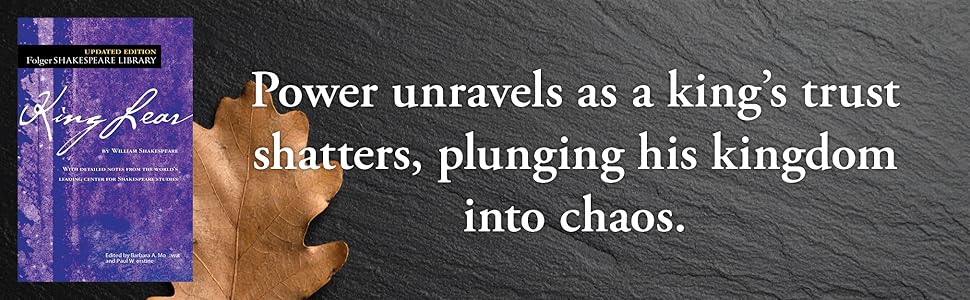
desertcart.com: King Lear: 9780743482769: William Shakespeare, Barbara A. Mowatt, Paul Werstine: Books Review: The Love-Trials of King Lear... - "King Lear" is Shakespeare's most profound utterance. It is a work whose theme is love; its major concern is with the centrality of love in the formation of character and with justice, both social and divine. The final scene, which confirms this reading, is one of the great achievements of world literature. The play opens with the aging king dividing his kingdom among his three daughters in return for their declarations of love. King Lear gives love uncontrollably and expects to be loved in the same fashion. He tells us that he loved the little one, Cordelia, best (I.i.137, 245, & 336) and we must thus assume the most violent resentment on the part of the two elder daughters, who have learned to say not what they feel but what they ought to say. Cordelia's honestly proclaims that her future husband will of necessity have to share in her love with her father and this is understood by the latter as a complete rejection, worthy of curses and banishment. The "subplot" concerning Gloucester's two sons, Edgar and Edmund. We can understand Gloucester's love for both of his children as a relatively recent phenomena having required the gradual overcoming of his embarrassment at his younger son, Edmund's, illegitimacy (I.i. 10). That Edmund has overheard his father's disparaging opening comments to Kent is confirmed by his paraphrasing of them in the second scene (I.ii. 18) and that this shaming has been a part of Edmund's experience since childhood appears probable in light of his final, transformative reaction to the unexpected and unknown feelings of love and pity experienced by him at the end of the play. The motif of "nothing," "nothingness" is hammered throughout the play. Having given away his love and receiving none from his remaining daughters Lear becomes 'nothing,' ontologically empty ("Lear's shadow"). Edgar, likewise experiences his rejection by his father - on faulty and conspiratorial premises - as an annihilation of his being ("Edgar I nothing am"). "He childed like I fathered," says Edgar of his godfather Lear. The comparison is that between two egos who know only the need to love and have been annihilated by the rejections they have experienced from the individuals whom they love. Edgar's transformation into Tom of Bedlam is not only a practical disguise but an acting out of this loss of identity (consider that he continues to use mad Tom's vocal mannerisms even in soliliquy [III.vii.126]) and his refusal to reveal himself to his father perhaps until he is ready to undertake an act which will justify his being loved again (III.vii. 121-124). Those who love give away all; those who feel no love take everything in order to make up for the emptiness. Edmund, Regan, Goneril and Cornwall seem always conscious of their desire to conquer even more power. Yet those who suffer hardship in this play seem to react in two ways - 1) they experience *ever increasing degrees of empathy,* by which they commit themselves to the relief of others through acts of, and belief in, social justice, and 2) they *imagine a system of divine justice,* by which they attempt to reconcile themselves to what's been lost. Edgar testifies that he has witnessed madmen, buffeted by nature, threatening others to do them enforced "charity" by piercing their own numbed arms in terrifying display. We have just seen such a thing occur with Edmund in Act II, scene i. We also know that he has called upon Nature as his goddess. Thus what we have here (like 'the Turk' in "Othello") is a rare Shakespearean metaphor: Edmund is Nature. King Lear's own pronouncement to the howling storm on the heath - "Nor rain, wind, thunder, fire, are my daughters... I never gave you kingdom, call'd you children/ You owe me no subscription: then, let fall/ Your horrible pleasure" further illustrates the point. In "King Lear," Nature is the lack of love. It is loveless and existential. It is godless; god and the astrological being an ego defense. It is "nothing." The poetry of "King Lear" is magnificent, perhaps not quite achieving the measureless heights of "Macbeth" or "Othello," but sonorous and extraordinarily beautiful. The two feuding brothers, Edgar and Edmund, are among Shakespeare's most profound creations. The Duke of Cornwall is one of his great monsters. And King Lear is one of his most tragic heroes. The Folgers editions conflates the Quarto and Folio editions. This is common practice for Shakespeare but both versions are so different (Shakespeare died before he could edit his complete ouvre for publication) that many editors have recommended to their readers that they embrace either one or the other. I personally would not recommend this since I think thematically the work is more difficult to interpret without the combining of a few lines found in only one or the other of the two editions (Q's "He childed like I fathered," not found in F, goes a long way towards explaining Edgar's character). There are so many classic scenes in this masterpiece of masterpiece, and so much characterization filled with insight and wisdom, and subtlety in its construction and beauty in its poetry, that reading or re-reading this play is an experience quite unlike any other. It is *the* major work by one of *the* major artists in world culture. Review: Read King Lear--it's the best. - What's not to like about the best Shakespeare play--and this Folger Shakespeare Library edition is wonderful and required by the teacher of a class through the Santa Monica Emeritus program. And go see the play when it's in your town.


| ASIN | 074348276X |
| Best Sellers Rank | #5,958 in Books ( See Top 100 in Books ) #7 in British & Irish Dramas & Plays #12 in Shakespeare Dramas & Plays #15 in Performing Arts (Books) |
| Customer Reviews | 4.6 4.6 out of 5 stars (974) |
| Dimensions | 4.19 x 0.9 x 6.75 inches |
| Edition | Annotated |
| ISBN-10 | 9780743482769 |
| ISBN-13 | 978-0743482769 |
| Item Weight | 6.4 ounces |
| Language | English |
| Print length | 384 pages |
| Publication date | January 1, 2004 |
| Publisher | Simon & Schuster |
| Reading age | 12 - 17 years |
R**O
The Love-Trials of King Lear...
"King Lear" is Shakespeare's most profound utterance. It is a work whose theme is love; its major concern is with the centrality of love in the formation of character and with justice, both social and divine. The final scene, which confirms this reading, is one of the great achievements of world literature. The play opens with the aging king dividing his kingdom among his three daughters in return for their declarations of love. King Lear gives love uncontrollably and expects to be loved in the same fashion. He tells us that he loved the little one, Cordelia, best (I.i.137, 245, & 336) and we must thus assume the most violent resentment on the part of the two elder daughters, who have learned to say not what they feel but what they ought to say. Cordelia's honestly proclaims that her future husband will of necessity have to share in her love with her father and this is understood by the latter as a complete rejection, worthy of curses and banishment. The "subplot" concerning Gloucester's two sons, Edgar and Edmund. We can understand Gloucester's love for both of his children as a relatively recent phenomena having required the gradual overcoming of his embarrassment at his younger son, Edmund's, illegitimacy (I.i. 10). That Edmund has overheard his father's disparaging opening comments to Kent is confirmed by his paraphrasing of them in the second scene (I.ii. 18) and that this shaming has been a part of Edmund's experience since childhood appears probable in light of his final, transformative reaction to the unexpected and unknown feelings of love and pity experienced by him at the end of the play. The motif of "nothing," "nothingness" is hammered throughout the play. Having given away his love and receiving none from his remaining daughters Lear becomes 'nothing,' ontologically empty ("Lear's shadow"). Edgar, likewise experiences his rejection by his father - on faulty and conspiratorial premises - as an annihilation of his being ("Edgar I nothing am"). "He childed like I fathered," says Edgar of his godfather Lear. The comparison is that between two egos who know only the need to love and have been annihilated by the rejections they have experienced from the individuals whom they love. Edgar's transformation into Tom of Bedlam is not only a practical disguise but an acting out of this loss of identity (consider that he continues to use mad Tom's vocal mannerisms even in soliliquy [III.vii.126]) and his refusal to reveal himself to his father perhaps until he is ready to undertake an act which will justify his being loved again (III.vii. 121-124). Those who love give away all; those who feel no love take everything in order to make up for the emptiness. Edmund, Regan, Goneril and Cornwall seem always conscious of their desire to conquer even more power. Yet those who suffer hardship in this play seem to react in two ways - 1) they experience *ever increasing degrees of empathy,* by which they commit themselves to the relief of others through acts of, and belief in, social justice, and 2) they *imagine a system of divine justice,* by which they attempt to reconcile themselves to what's been lost. Edgar testifies that he has witnessed madmen, buffeted by nature, threatening others to do them enforced "charity" by piercing their own numbed arms in terrifying display. We have just seen such a thing occur with Edmund in Act II, scene i. We also know that he has called upon Nature as his goddess. Thus what we have here (like 'the Turk' in "Othello") is a rare Shakespearean metaphor: Edmund is Nature. King Lear's own pronouncement to the howling storm on the heath - "Nor rain, wind, thunder, fire, are my daughters... I never gave you kingdom, call'd you children/ You owe me no subscription: then, let fall/ Your horrible pleasure" further illustrates the point. In "King Lear," Nature is the lack of love. It is loveless and existential. It is godless; god and the astrological being an ego defense. It is "nothing." The poetry of "King Lear" is magnificent, perhaps not quite achieving the measureless heights of "Macbeth" or "Othello," but sonorous and extraordinarily beautiful. The two feuding brothers, Edgar and Edmund, are among Shakespeare's most profound creations. The Duke of Cornwall is one of his great monsters. And King Lear is one of his most tragic heroes. The Folgers editions conflates the Quarto and Folio editions. This is common practice for Shakespeare but both versions are so different (Shakespeare died before he could edit his complete ouvre for publication) that many editors have recommended to their readers that they embrace either one or the other. I personally would not recommend this since I think thematically the work is more difficult to interpret without the combining of a few lines found in only one or the other of the two editions (Q's "He childed like I fathered," not found in F, goes a long way towards explaining Edgar's character). There are so many classic scenes in this masterpiece of masterpiece, and so much characterization filled with insight and wisdom, and subtlety in its construction and beauty in its poetry, that reading or re-reading this play is an experience quite unlike any other. It is *the* major work by one of *the* major artists in world culture.
R**Y
Read King Lear--it's the best.
What's not to like about the best Shakespeare play--and this Folger Shakespeare Library edition is wonderful and required by the teacher of a class through the Santa Monica Emeritus program. And go see the play when it's in your town.
L**Y
Out damned spot!
Just kidding, that's the wrong book. I loved King Lear! Not the character. He sucked. The book was amazing though.
Z**N
looked annoying to hold
I'm not here to talk about the content of the book itself, but more about how this edition is extremely helpful in understanding the Shakespearean language. It's an average sized study book, unlike most of the ones that my fellow students bought which was a smaller version of this book and in all honesty, looked annoying to hold. Came in great condition and got me through my English course.
A**.
Play
Just perfect.
C**Y
One of the classic
A great book was recommended by a teacher.
M**Y
Great actor text
Fits in your back pocket.
P**P
Superb Edition of a Superb Play
This is a review of this specific edition, not of the actual play. If you haven't read King Lear, read it. Simple as that. As for the actual physical product, I am very pleased with it. Everything about it is of high quality, and it feels wonderful in your hands. The size is much larger than the typical Folger Shakespeare release, allowing the text to be easily read and ample room for annotations. I would definitely recommend this specific edition to any student (in college or, like myself, high school) wanting a nice copy of King Lear for yourself to read and study. Of course, if you are only looking for a copy to read for pleasure, this is excellent for that purpose as well. The accompanying essays are very interesting and insightful, but I believe they are also available with the smaller Folger edition, so they should not be the deciding factor in purchasing this more expensive edition over the smaller, less expensive one. Overall, this is a very well-made product. The cover and pages are high quality, and the book is a pleasure to hold. Highly recommended!
T**O
A Folger deve ser a pior edição que já encontrei das peças de Shakespeare. Encadernação ruim, tinta de baixa qualidade, notas com poucas informações sobre as peças, papel ruim (10 reais seria um bom preço para o produto, não 20-50). Melhor tentar as edições já famosas: Norton, Arden, Oxford (na versão individual, comentada), Riverside etc.
N**A
Amazing book
S**A
Nice book from Folger. Each page of text contains side by side annotations & meanings. That really helps the second language readers. The topics discussed before the text is really very important. Like Shakespeare's language, his theatre, his life, summary of the drama etc.. Overall a worthy book in such a low price. And the critical passages provided at the end chapters of the book should get high praise. Thanks Folger Classic Library.. Thanks also to Amazon.in for so fast delivery..
A**E
Super to read again.
C**N
pas un véritable Folger, l'éditeur indiqué en couverture ne correspondait pas et la qualité et la texture de la couverture ainsi que les dimensions du livre ne sont pas celles des livres Folger. L'intérieur est suffisamment bien fait pour consulter les ouvrages.
Trustpilot
3 days ago
2 weeks ago