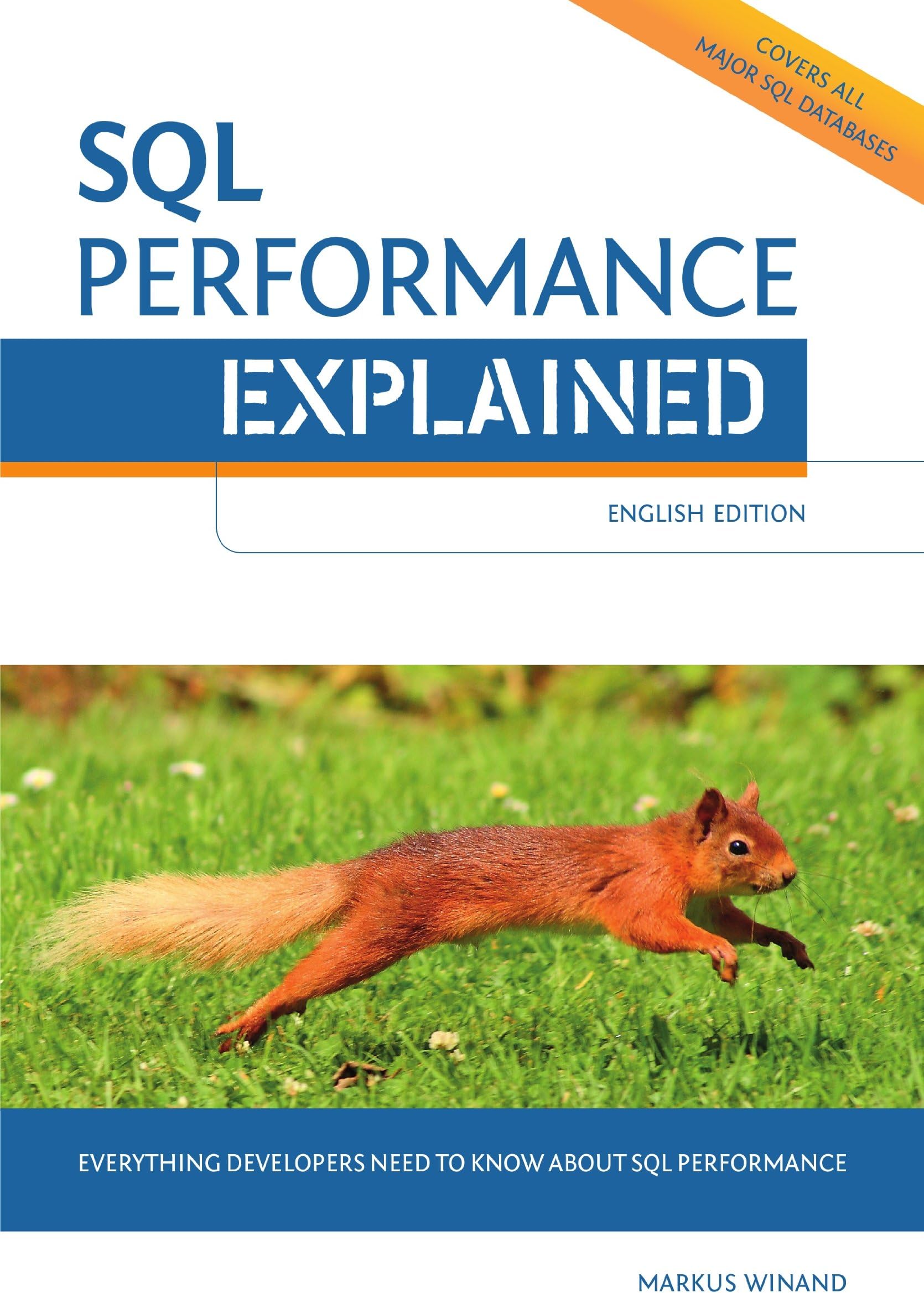
SQL Performance Explained
Product ID: 66162535
Desertcart purchases this item on your behalf and handles shipping, customs, and support to Cayman Islands.
SQL Performance Explained helps developers to improve database performance. The focus is on SQL—it covers all major SQL databases without getting lost in the details of any one specific product. Starting with the basics of indexing and the WHERE clause, SQL Performance Explained guides developers through all parts of an SQL statement and explains the pitfalls of object-relational mapping (ORM) tools like Hibernate. Topics covered include: • Using multi-column indexes • Correctly applying SQL functions • Efficient use of LIKE queries • Optimizing join operations • Clustering data to improve performance • Pipelined execution of ORDER BY and GROUP BY • Getting the best performance for pagination queries • Understanding the scalability of databases Its systematic structure makes SQL Performance Explained both a textbook and a reference manual that should be on every developer’s bookshelf. Covers all major databases: Oracle® Database, SQL Server®, PostgreSQL, MySQL What readers say: “This book is definitively worth having in the company library.” — Joe Celko Review: An eye-opener on SQL performance - before: 'Hmm, I need to do the thing with the data'; hack together SQL in Squirrel until it gives the correct answer; copy SQL into program; think 'it worked in dev and test' when it turns out to be horribly slow in production; sprinkle indexes; see moderate improvements; leave alone. now: 'Hmm, I need to do the thing with the data'; write SQL to get data, bearing in mind table indexes, join criteria, and the ease with which the database optimiser will be able to narrow down to the target data; run explain plans and check costs; remember that I need real data volumes for the explain plans to be representative of production, and repeat; copy SQL into program; never hear about it again. And all in less than two hundred pages which--while they could be quickly summarised as 'use indexes effectively'--don't waste any time with history lessons, edge-cases, or other forms of padding. Throughout this, it still manages to highlight the differences between Oracle, SQL Server, MySQL and PostgreSQL. I can't really offer any criticism here, hence the five stars, but if there is ever going to be a follow up then I'd like to see some coverage of DB2. Review: Delivers Results - I have a database with 7.5 million records and I was struggling with a query that was taking about 1 minute, 30 seconds to execute. 43 pages in and it is now executing in 3 seconds. This is exactly the result I was looking for. This is a technical book, aimed specifically at application developers, however it is well written and is not too heavy on the guts of databases. The first part of the book explains indexing very clearly and very simply. It then goes on to highlight the finer points of joins, sorting, clustering etc. Worked for me.
| Best Sellers Rank | 620,649 in Books ( See Top 100 in Books ) 66 in SQL Databases |
| Customer Reviews | 4.6 out of 5 stars 108 Reviews |
D**S
An eye-opener on SQL performance
before: 'Hmm, I need to do the thing with the data'; hack together SQL in Squirrel until it gives the correct answer; copy SQL into program; think 'it worked in dev and test' when it turns out to be horribly slow in production; sprinkle indexes; see moderate improvements; leave alone. now: 'Hmm, I need to do the thing with the data'; write SQL to get data, bearing in mind table indexes, join criteria, and the ease with which the database optimiser will be able to narrow down to the target data; run explain plans and check costs; remember that I need real data volumes for the explain plans to be representative of production, and repeat; copy SQL into program; never hear about it again. And all in less than two hundred pages which--while they could be quickly summarised as 'use indexes effectively'--don't waste any time with history lessons, edge-cases, or other forms of padding. Throughout this, it still manages to highlight the differences between Oracle, SQL Server, MySQL and PostgreSQL. I can't really offer any criticism here, hence the five stars, but if there is ever going to be a follow up then I'd like to see some coverage of DB2.
M**.
Delivers Results
I have a database with 7.5 million records and I was struggling with a query that was taking about 1 minute, 30 seconds to execute. 43 pages in and it is now executing in 3 seconds. This is exactly the result I was looking for. This is a technical book, aimed specifically at application developers, however it is well written and is not too heavy on the guts of databases. The first part of the book explains indexing very clearly and very simply. It then goes on to highlight the finer points of joins, sorting, clustering etc. Worked for me.
D**.
Very good book
I purchased this book principally for learning SQL tunning/Performance for oracle database however the book covers several widely used DBMS such as oracle, PostgreSQL, mysql, sql server, MySQL, . . . The domain is quite vast & as a beginner, if you just check the online oracle documentation, you can hardly find your way. This book opens the door. You learn the basic concepts and terminology (what is a BTree index, how it is read and how it can impact performance). There are many interesting examples, each of them, provided with execution plans. At the end of the book there is a summary of how to read an execution plan (dedicated section for each DBMS) The author uses a simple language and in general it seems that the book addresses principally those who almost don't know much about the performance problems. Yet I believe non beginners can also benefit from the interesting scenarios described in the book for investigating and tackling performance problems (very good & classic examples) The accent has been put on indexes. You will learn different type of indexes, how to improve them, how a database read an index, doing different type of index/table scans, how to investigate the cause of a slow query, etc. Personally I liked the book and I recommend it. I would've preferred to see more details in the book about the meaning of each section of an execution plan. Also it would be more helpful if the author gives more details about hash joins and hash group by. My conclusion: Excellent book and I recommend it.
A**N
Essential reading
Essentially the secret is indexing but creating the correct indexes is still a skill. This book clearly explains how indexing works and how to indentify what indexes are required. Performance is often an afterthought but this book should be essential reading for all developers so that performance considered before it becomes an issue.
L**D
I could not recommend this book enough
An absolute must for anybody who cares about database performance, the guy knows what he's talking about and explains everything clearly and concisely. I could not recommend this book enough.
G**E
Probably the best book on SQL performance I've read
This book is easy to read, but still really informative. It helps simplify the whole process a database system goes through to execute SQL queries. It helps understand how to write faster queries. A really impressive job done by Markus Winand.
S**K
Most useful book I've read
Most useful book I've read, taking into account its size. Bought it only for Sql Server explanations, but learned something about Oracle too. Willing to take profiler and improve, improve, improve... Seriously speaking - coherent explanation of tough stuff and putting into system a lot of fragmentary pieces of knowledge.
H**Y
Key SQL indexing concepts are explained without getting into unnecessary details. A must have for all developers who ...
This book is so well written. Key SQL indexing concepts are explained without getting into unnecessary details. A must have for all developers who deal with SQL!
D**I
Libro bellissimo
E' un libricino che si legge velocemente contenente tanti dettagli e consigli sull'utilizzo degli indici dei database relazionali (in particolare il libro si riferisce maggiormente ad Oracle). Davvero una bella (ed interessante) lettura!
D**T
This is a very good, but very technical book!
This is a very good, but very technical book! If you want to understand what is going on behind the scenes, understand things like how Indexing, and even the order in which you create indexes can drastically impact performance, ... this book will enlighten you. I do not think this book is for a beginner though, simply too advanced. SQL Performance Explained
C**R
nice overview of indexes and SQL performance - PDF version is an extra charge
From a developer perspective, this book provides an excellent overview. It does a bit of glossing over some topics such as bind variables. For example, it does not go into the details on how bind variables are handled by Oracle 11. However, it at least concisely explains the high-level concepts and the potential issues. This book is the minimum that a developer should know when working with Oracle. It feels like this book was written by a developer because the author gets to the point and is concise. He says what should be said in one sentence or one page versus wordy authors that might take several pages or an entire chapter to say the same thing. Almost like working with a development tech lead who has good communication skills. The PDF version of this book is not free. Meaning, you have to purchase it: extra cost beyond the price of buying the printed book. I typically only buy kindle books. This is the one rare instance I purchased a print-only book because I thought I would get a PDF file for free. Only having the print version of this book is going to make it difficult to use as a continuous reference, and so I'll buy the PDF version from the author's web site. This is the first time I can recall having to pay for the PDF version of a book. Today, I only care about Oracle, and so the sections that describe how the other databases work are not useful to me. I also do not use an ORM tool, and so the sections on ORMs are also not useful to me. However, if you are going to write a SQL book with the focus being "developers" then I can see how these other sections can be potentially useful to any developer who is working with SQL. Overall, it is a great book to help a developer get quickly started with SQL performance.
P**N
Das Buch bringt alles was man braucht auf den Punkt.
Super Buch. Es hat mir bei der Arbeit schon so einige Male weitergeholfen. Ohne viel unnötiges Rauschen bringt der Autor das Essentielle, was für den Entwickler wichtig ist auf den Punkt und hilft mit praktischen und anschaulichen Beispielen.
L**S
Sehr teuer
Ich denke, es müsste günstiger zu haben sein... Inhaltlich supi.
Trustpilot
1 month ago
1 day ago